
Apr 2, 1885
Once we had replenished our supplies, we made our way north. Not long after setting forth a frightening apparition appeared before us. It called itself Arronax, and wanted to know if I was *really* the Living One – if Nasrudin was “hiding in my bones”. It threatened that the world would “once more shake before its power” and all we loved would be destroyed!

And then, as if to emphasise the point it knocked us all senseless with a single blast of magick, and vanished!

I knew not to what degree it could carry out its threats. But clearly whoever or whatever Arronax was; it was a dangerous adversary. And it believed in the same prophecy that Virgil had professed. I desperately needed to understand the nature of these events. Who or what was Arronax? What did it want? What was the nature of its conflict with Nasrudin? And what did any of that have to do with me specifically? But all I could do is continue my investigations, and follow where they led. We pressed on towards the Wheel Clan.
Apr 7, 1885
Today we were accosted by Orcish bandits lying in wait along the road. They threatened us in crude growls and gestures. But when they approached and saw my face their demeanour changed instantly. In far less broken speech they apologised for waylaying a “sister”, and claimed they were only making a living harassing human travellers. I could not say that I approved of their chosen profession, but I was glad that bloodshed could be averted – whatever the reason.

Apr 10, 1885
When we arrived at the location that Thorvald had indicated, it looked desolate and empty – with no sign of occupation. But as promised, Thorvald’s spectacles revealed a hidden entrance.

Inside we were met by dwarven guards. When we explained our quest we were directed to see King Thunderstone.

The entrance to the throne room was an impressive edifice of stone and iron.

Inside we were greeted not by King Loghaire as we had expected, but by the King-in-Waiting, his son Randver. Randver told us that Loghaire had been so distraught over allowing the banishment of the Black Mountain Clan – at the behest of Elves no less – that he had banished himself to the Dredge. The Dredge was a long abandoned maze of tunnels far beneath the Wheel Clan proper. He was furious with Mr Bates for having stolen dwarven technology. Disparaging of humans for rapidly expanding it without heed for the consequences. And distrustful of the Elves’ motives in demanding that the dwarves be held to account.

We discussed with him the finer points of Stone and Shape – the fundamental philosophy of dwarven ethics – so that I could properly understand his father’s mindset. He then gave us permission to search the Dredge. I rather suspected Randver knew more than he was admitting. It seemed highly unlikely that the legendary dwarven High King could simply slip away un-noticed. But for now I held my tongue.
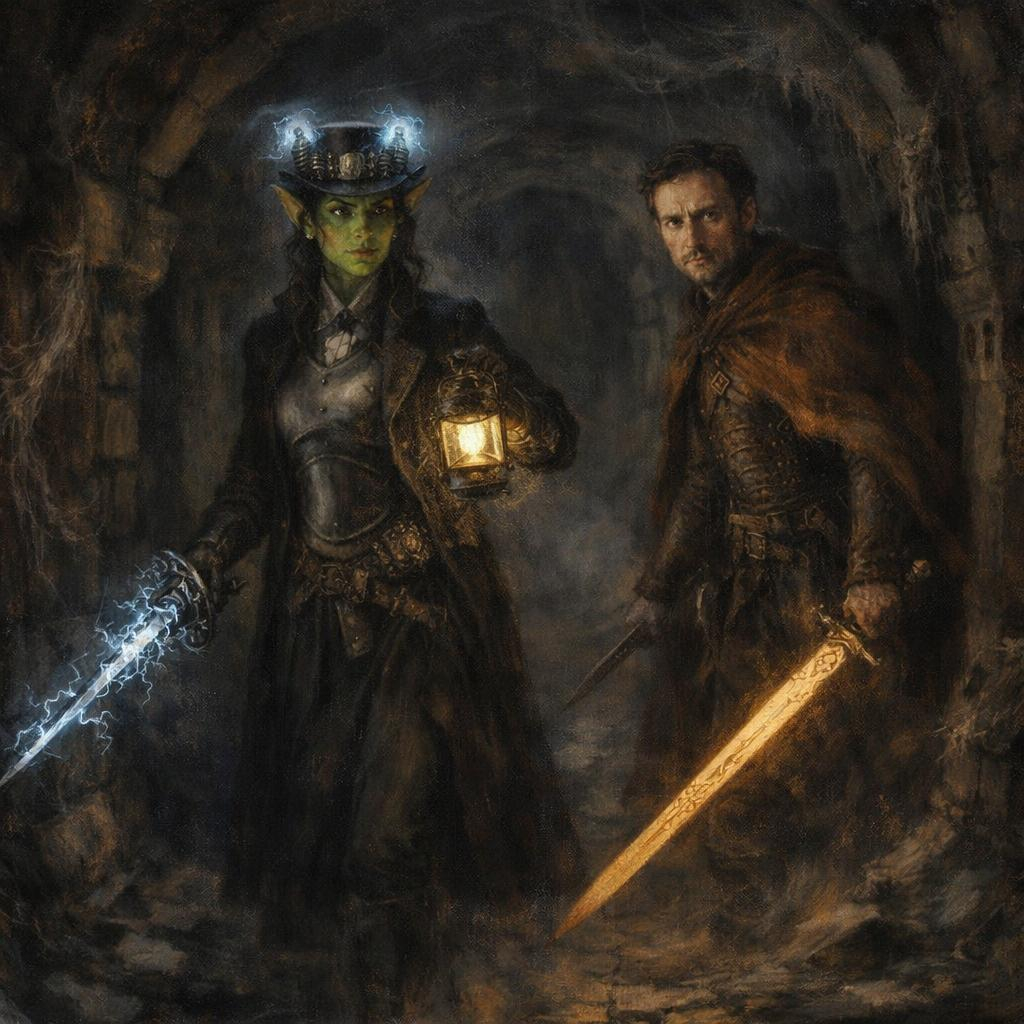
The Dredge proved as foreboding as described – a dark, and ominous locale hinting at tragedies long past and secrets long forgotten.

Unfortunately it was was not entirely uninhabited. Gigantic spiders lurked in the tunnels.

Ore golems as well – much as we had encountered in the Black Mountain Mines. But this time we were far better prepared for their unique challenges.

We chanced upon a group of dwarven miners who had barricaded themselves in a small chamber. It seemed that they had accidentally disturbed a nest of crystalline spiders, and could not return for fear of the dreaded queen. Jayna and Virgil helped to patch them up as they could.

And then we dispatched the monstrosity to clear their way home.

In another area Werewolves prowled – ambushing us as we searched. Fortunately we had prudently retained a supply of silver arrows among our equipment.

And even their monstrous albino patriarch we eventually brought low.

Finally, in a dark and secluded cave, we found King Loghaire. Dressed in rags and living in isolation. He was gruff and reticent to speak at first, but I was eventually able to convince him that we meant to help the Black Mountain dwarves.

He told us that the Silver Lady of Qintarra, Queen of the Elves, had demanded the BMC be banished as reparation for harm done to the elves. Her emissary had told him she was furious. The ancient forests of Morbihan had been clear-cut by humans – a sacred place to the Elves. And there would be war if there were not consequences. He had believed such war would have been catastrophic for all.
He had wanted to deal with the BMC himself, but the Elves had insisted that as the wronged party it was their right. An elf named M’in Gorad had been the Silver Lady’s messenger – and Loghaire did not know to where the dwarves had ultimately been exiled.
As I pressed him for details a number of inconsistencies struck me. He claimed he had never known the elves to be warlike, and had never known the Silver Lady to be rash. To his mind she had always been direct and forthright in their dealings. And it seemed all discussion of the matter had been through M’in Gorad rather than direct. As I reviewed the sequence of events with him he too began to see that the details did not quite fit together.
He told us that no-one knew precisely where Qintarra lay hidden – but it was somewhere in the Glimmering Wood, near Stillwater. And that an elf named Myrth was known to frequent the town. I intended to find it and investigate further. Something more was happening here than the surface facts.
I pressed him on exactly why had exiled himself. He believed that he had failed both his people and his purpose by allowing the BMC to be exiled. That he had betrayed both his Stone and his Shape. I convinced him that the actual betrayal lay in abandoning his people afterwards, rather than continuing to lead and attempting to rectify the situation. And after a long and silent pause for consideration, he agreed. He would return to the Wheel Clan, and do all in his power to assist us in getting to the heart of the matter.
In gratitude he presented Magnus with Harrower – the ancestral axe of the ThunderStone line. Magnus was overwhelmed, and speechless.

We turned to make our way back through the Dredge, but the King held up his hand. It seemed there was a direct passage back to the throne room! I had been quite correct! Randver had known *exactly* where Loghaire was – and the King had not been so selfish as to make himself entirely unreachable. I had surmised that the dwarven focus on clan, honor, and family would not have allowed him to abandon his father to his fate. And I knew as well why Randver did not offer the direct route from the beginning. We were unproven to him. Our Stone was unfamiliar and our Shape untested.
April 12, 1885
As we returned to Stillwater, we were ambushed once again – this time by Molochean hand agents. Assassins led by a necromancer! They were growing bolder and more direct in their pursuit. And we still did not understand their connection to Arronax, Bates, and other events.

April 14, 1885
We located Myrth in Stillwater, and he proved quite true to his namesake. He would not directly answer my questions, instead twisting my words and answering with technically correct non-answers. But he had nothing on Lady Anabella. I had been using that method with her when feeling uncooperative since I had been quite small, and I had learned from a master how to turn that game back on itself. He conceded defeat with a smile.
He told us that he did indeed know where one could find Qintarra. But he would only vouchsafe its location if we proved ourselves first. He wanted us to bring him the pelt… of the Stillwater Giant. Of course. What else?

The resident expert on the Stillwater Giant was a man named Stanley Xavier Hippington – who called himself a Professor of Cryptozoology. He lived in a rather eclectic cottage on the outskirts of town, and apparently made a living retelling the secrets of the mysterious beast to wide-eyed true believers.
He claimed the Stillwater Giant was so elusive because it was a natural shape-shifter. It disguised itself in a ridiculous shape few would believe, and only took its true form when threatened or hunting. Its disguise was apparently that of a bright blue rabbit…

Even more difficult to take seriously was his plan to capture the beast. He claimed that he had designed a cage of material specifically calibrated to interfere with the beast’s magickal morphic aura – preventing it from transforming. A cage that appeared to me to be nothing more than brass.
Worst of all was his plan to safely approach and entrap the beast. He gave me a foul-smelling vial of liquid which he claimed to be “Giant Musk”. He suggested that I remove my armour and garments, slather myself in this noxious concoction, and then carefully approach it while it was in rabbit form to capture it. I offered that we would “take his plan under advisement”.
He related that the beast’s lair was a large cave not far from his cottage. It looked ominous enough, with the scattered bones in front adding to its ambiance.

Inside we found what appeared to be nothing more than a simple jackrabbit – save for its odd cerulean hue. I refrained from following the professor’s rather questionable instructions, and instead slathered his concoction on the cage itself. Virgil and Magnus endeavoured to carefully herd the animal until I could spring the trap upon it.

Upon returning with our prize to Professor Hippington, he insisted that we take it to the Zoological Society in Tarant to be certified. I was getting the sinking suspicion that this was a setup.
April 21, 1885
After returning to Tarant we approached Dr. Tristan Fenwick – chair of the Zoological Society. As I had unfortunately anticipated he found the entire affair hilarious and could not contain his amusement. He proclaimed our specimen to be a sterling example of Lepus caeruleo pictus. Otherwise known as “rabbit painted blue”.

Fed up at this point with the entire affair – and suspecting the entire quest to be a practical joke at our expense – I decided to match Myrth at his own game. We stopped in at H.T. Parnell’s Museum of Curiosities – a tourist attraction in Tarant displaying a variety of mythical artefacts of dubious origins. Among the specimens on display was a crudely stitched together pelt of the Stillwater Giant – advertised as having been slain in ferocious battle with the famous adventurer Franklin Payne. I offered to exchange our “Lepus caeruleo pictus” for his pelt – allowing him to claim the pelt had been stolen in mysterious circumstances. He was quite taken with the idea.

Mar 14, 1885
We returned once more to Stillwater with our “authentic pelt” in hand. As expected, Myrth was not fooled in the slightest… but he was absolutely delighted with our solution to his “quest”. To him it was precisely in the spirit of the exercise. He told us how to locate the hidden vale concealing Qintarra, and insinuated that he could already envision a plethora of amusing ways to make use of our gift..

We left Stillwater and headed for Qintarra – through hills leading to the Glimmering Forest. As we traversed the passage, I felt the oddest sensation of being watched. I looked back as the others forged ahead, and saw the most curious sight. A small blue rabbit – almost luminescent in the fog – staring at me in a most uncharacteristic manner. As I watched, I could see its form begin to shimmer and grow – taking on a large and now familiar form. Like and yet unlike any of the caricatures I had seen in Stillwater. I hesitated for a moment – considering drawing the others’ attention. But instead I merely nodded to it and turned away. Not all mysteries needed to be exposed. I would let this one remain hidden a little longer.

Author’s Notes:
I know you can talk Randver into giving you direct access to the King from the outset, but that feels like circumventing half the quest. The long way just “feels” more satisfying.
As for the Stillwater Giant… what can I say. In some ways Cass can still be a romantic at heart.


Leave a Reply